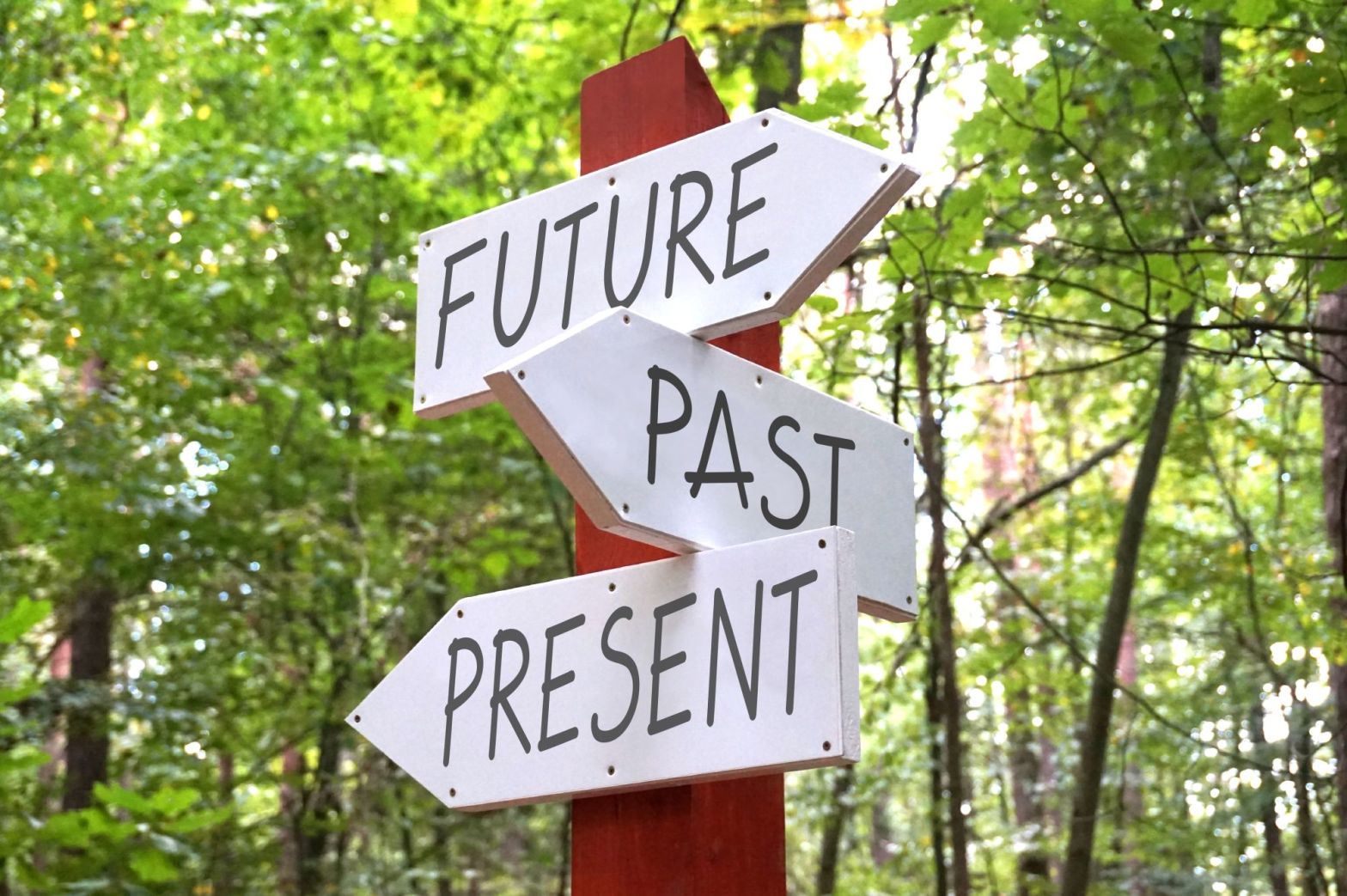
Whether you’re reading a book, watching a film or following a TV series, one thing seems increasingly consistent — the story isn’t told in sequential order. Perhaps it’s just an occasional flashback, or perhaps the entire story is being told in multiple timelines, but the journey from A to B is rarely a straight line.
Now, I love a good out-of-sequence story. One of my favourite quotes is that “A story should have a beginning, a middle and an end, but not necessarily in that order.”1 I do recognise, though, that it can be an extremely confusing and annoying approach when used badly.
So how do flashbacks and multiple timelines work, and how can they be used most effectively?
Simple Flashbacks (or Flashforwards)
Sometimes there’s only one flashback in a story, or else they’re scattered sparingly throughout. And, like pretty much anything in the way you tell a story, there are right and wrong ways of doing them.
A flashback shouldn’t be used because you want to show something cool, nor because it’s easier than weaving the information into the story in a more integrated way, such as dialogue. A flashback is only needed when its events need to be seen, not merely referred to, and there’s a compelling reason not to bring it in until this point.
One of the uses of flashbacks that I always hate (normally in films or TV shows) is when a brief flashback is stuck in simply to remind the viewer of a past event relevant to the current events — on the assumption that viewers have the memory of a goldfish with dementia.
This isn’t always wrong. The cascading flashbacks that accompany the reveal of the twist in The Sixth Sense worked well enough for me (or, at least, would have done if I hadn’t guessed the twist nearly an hour earlier2). But don’t just use a flashback because you don’t trust your audience.
And what about flashforwards? That would be when you tease an event that’s yet to come, and it can be effective if you’re very sure of what you’re doing. The only times I’ve used a flashforward have been as part of a more complex multiple time structure — which I’m coming to next.
Nonlinear Storytelling
One of the things authors are regularly told nowadays is not to start their story at too early a point. This wasn’t always the case. Many Dickens novels, for example, start with the main character being born and growing up, before getting to where anything interesting happens.
Today’s fashion in stories, however, is to start just before the point everything changes for the main character, whether that’s undertaking the quest, being told about the murder or meeting the relevantly gendered person of their dreams. Everything before that, we’re told, is back-story and therefore of very limited relevance.
The advice on where to start is generally good, but it’s not necessarily true that anything before is back-story, and certainly not that it’s irrelevant. Sometimes it’s simply that the story begins long before the right place to start it. For instance, the character’s childhood may actually be an essential part of the story, but not something you want to introduce the reader to before establishing the crucial events. In this case, you may want to scatter the earlier story throughout the main narrative.
This is the approach I took with At An Uncertain Hour.3 The “present” narrative is actually a very short period of less than twenty-four hours at the very end of the story. The 1st person main character, the Traveller, is facing the culmination of everything that’s happened to him over the three thousand years of his immortal life.
Of course, this doesn’t mean the flashback chapters can just be tossed in at any point. For one thing, what’s going on “now” and “then” should reflect one another in some way, as well as explaining one another. Besides the sections that simply relate earlier phases of the story, some of the flashbacks explain the Traveller’s attitudes and personality, while others comment on what’s happening in the “present”.
And the answer to the mystery that’s been set up in the “present” is actually revealed in a scene that happens three thousand years earlier.
Just like individual flashbacks, nonlinear storytelling can be done well and badly. Badly done, it can confuse the reader or viewer (it has the potential to be even more confusing in visual form than in writing) if they can’t tell what’s present or what’s past, or can’t see the point of the flashbacks. Whenever you’re using flashbacks (or flashforwards) of any kind, it’s essential to establish at least the when and where, if not the why, within seconds.
For my money, the best exponent of nonlinear storytelling4 is Iain Banks — with or without his M. Most of his best novels fill in the crucial events that are driving the present, with the solution often found in the past.5 One of his SF novels, Use of Weapons, begins in the middle and proceeds alternately forwards to the end and backwards to the beginning. I was slightly miffed when I read it, since I’d already used that structure myself, though with considerably less success.
Linear or Nonlinear?
Not all stories need to be told in the same way. Some proceed confidently from A to B, without any thought of diverting by way of Q or X, and that’s fine. Even those might fill in some details about the past, but without necessarily taking us back in time.
Other stories, though, have a more complex relationship with time and sequence, and for these a straight line simply doesn’t cut it. So, if that’s how your story needs to be told, then tell it that way — but remember that the techniques involved are much harder to get right.
If you don’t, you risk confusing your readers — and writing sins don’t get much worse than that.
1 I never knew where it came from, though. I looked it up for the purpose of quoting it here, and apparently it originates with Jean-Luc Godard.
2 Does that make me specially perceptive, or the twist weak? I’m not sure, but in fact guessing it didn’t spoil the rest of the film for me.
3 And also in the novel that’s currently resting between first and second drafts — but I haven’t got that quite right yet.
4 No, I haven’t read every author who uses nonlinear structure, and I’m perfectly happy to accept that your favourite is also brilliant.
5 It’s not remotely a coincidence that I was reading Banks’s brilliant novel The Crow Road at the time I began At An Uncertain Hour.
 The Fantasy Worlds of Nyki Blatchley