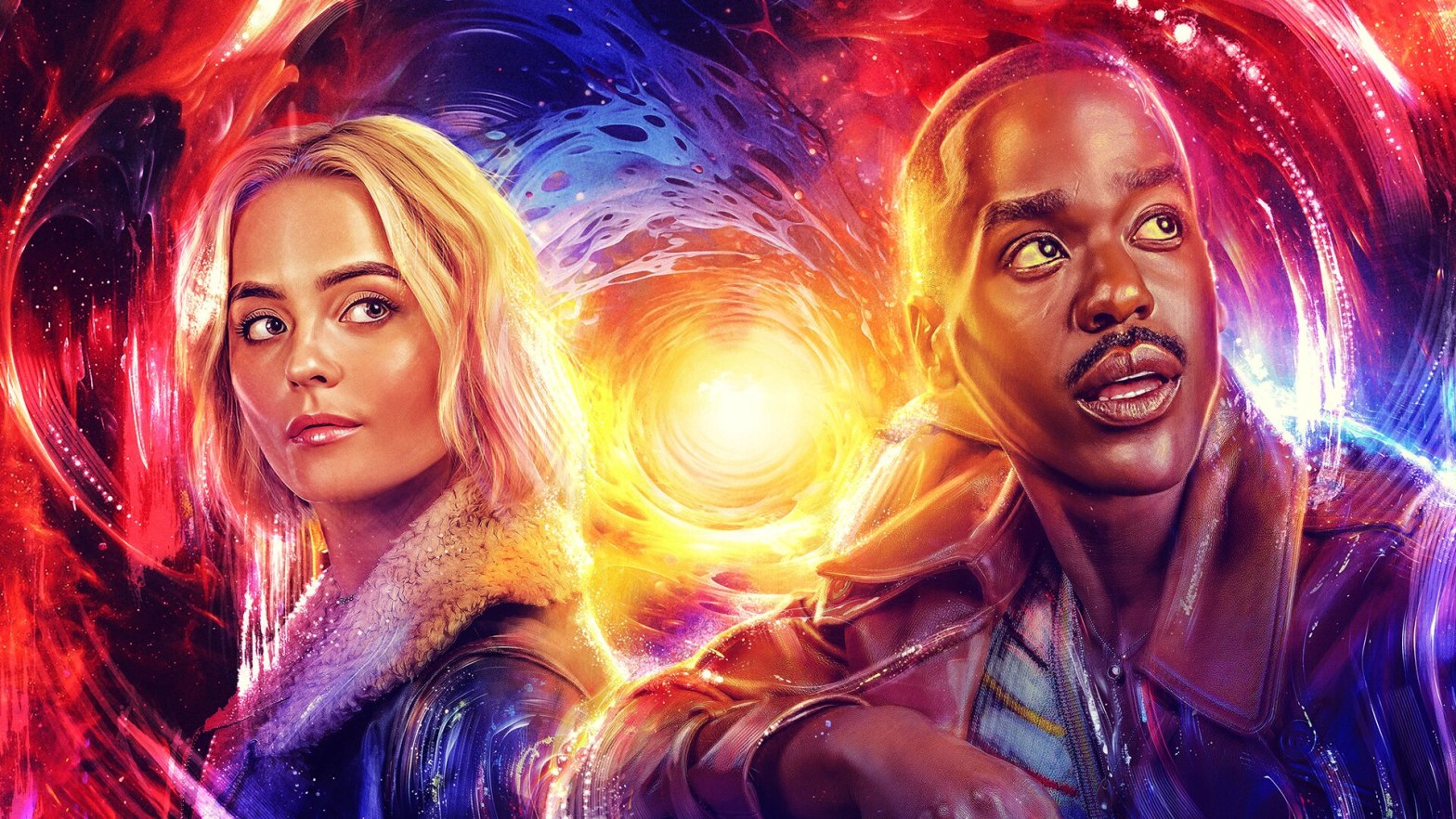
The most recent series of Doctor Who finished a couple of weeks ago. Due to Disney’s dictates, it’s officially described as Series 1, which has angered a lot of fans, who insist that it’s actually Series 14. Whereas, as us old-timers know, it’s really Series 40.
Whatever it’s called, though, I’ve now had time to rewatch and consider it, so here are some thoughts.
Overall, I enjoyed this series, although I do have some criticisms. Those don’t, though, include Ncuti Gatwa’s interpretation of the Doctor, which I like, and he and Millie Gibson as Ruby have shown excellent chemistry.
It’s always made sense to me that a regenerated Doctor would have the energy and enthusiasm of youth, rather than regenerating into a venerable elder (much as I’ve loved many of the venerable elder Doctors). Ncuti captures that perfectly, without sacrificing the feel of the millennia making up the Doctor’s past.
Of course, there have been accusations of “wokeness” from the usual suspects. I’ve always found “woke” a ridiculous word to use as an insult — how dare they actually be awake to things, instead of burying their heads in the sand? In any case, in practice it’s just a way for bigots to have the illusion of a moral high ground for their bigotry — in this case, especially about race and sexuality.
In any case, Doctor Who has never shied away from tackling important issues while it’s telling exciting stories. It first tackled racism in 1963 and did the first of many ecological stories the following year, while the two Peladon stories of the early 1970s directly (and not even very subtly) mirror political events in Britain at the time.
So what about the individual episodes?
WARNING: HERE BE (a few) SPOILERS
Episode 0 — The Church on Ruby Road
Actually the Christmas special, but it sets up the main recurring elements of the series, so should really be treated as part of it.
This does a good job of introducing the new Doctor and new companion, both to us and to each other. The goblins seem a bit left-field for Doctor Who, but I did like the way the Doctor described the “magic” as an alternative science — it reminded me of the Third Doctor story The Daemons.
What I didn’t like here was the musical number (although it’s better than what comes later) which seems like something straight out of Labyrinth. Now, I love Labyrinth, but what works there doesn’t necessarily work in Doctor Who. We had a musical number in The Giggle and there’s another later — enough.
The main threads set up here are the mystery of Ruby’s mother and the enigmatic neighbour Mrs Flood. The former is central to the story, while the latter is only hinted at in the final line of the episode. And we also have a brief, seemingly irrelevant appearance by the mysterious woman who follows the Doctor and Ruby throughout the series.
Episode 1 — Space Babies
This episode has got a fair amount of stick, and I’ve even seen it described as one of the worst Doctor Who stories ever. Well, it’s certainly no classic, but it’s also nowhere near that bad.
Space Babies is fairly light and silly (and has several significant plot holes) but I found it enjoyable enough. An abandoned “baby farm” in space is being run by the equally abandoned babies, who for some inadequately explained reason are still physically babies but mentally older kids. They’re menaced by the Bogeyman — whose name turns out to be disturbingly literal.
It’s technically very clever in the way it creates a convincing illusion of the babies speaking, and it gives the Doctor and Ruby more opportunity to bond, but as a story it’s rather throwaway. No worse than that, though.
Episode 2 — The Devil’s Chord
This seems like a great idea. The Doctor and Ruby go back to 1963 to watch the Beatles recording their first album, only to find that a malevolent power called Maestro has stolen all the music in the world. All the Beatles can muster up is drivel that wouldn’t even work as advertising jingles.
Somehow, though, it doesn’t quite gel. Maestro (played by drag artiste Jinkx Monsoon) is spectacular, although arguably too overpowering, but the Beatles themselves are not only underused, but also very poor as lookalikes. And, at the end, the whole thing dissolves into what can only be described as a music video that has nothing to do with the story — and isn’t even musically appropriate.
Perhaps the most interesting scene is where the Doctor tells Ruby that, at this time, he was living in east London with his granddaughter. This helps set up the finale and may well be relevant beyond the series.
Episode 3 — Boom
The first episode written by Stephen Moffatt since laying down the reins, and it’s an absolute stonker. Everything that makes a great Moffatt episode great: an unexpected situation, tension and drama, complex moral issues, great relationships, and a well-written, well-acted kid.
Briefly, the Tardis materialises in the middle of a war on a planet involving the Anglican Marines we’ve seen a number of times in the past, and the Doctor steps on a sentient land-mine. He has to find a way of getting away without setting it off, which would destroy half the planet — and stop the AI from “ambulance” killing everyone in the name of profit for its manufacturers.
If Space Babies represents the show at its most frivolous and childish, this is Doctor Who at its most grown up, exploring a relationship between war and capitalism that’s absolutely relevant to our own world. A very limited set and small cast, but a superb episode.
Episode 4 — 73 Yards
It’s unexpected to have a Doctor-lite episode so early in the run (it was apparently to do with Ncuti’s remaining commitments elsewhere) but it’s one of the more successful ones. In some ways, it’s a little reminiscent of Turn Left, showing the companion in an alternative timestream without the Doctor — but this one going forwards instead back.
Millie Gibson as Ruby does an excellent job of holding together a story that moves through many different time periods and a constantly changing cast. Along the way, she encounters a bunch of weird locals in a Welsh pub, meets Kate Stewart, and stops a terrifying prime minister from starting a nuclear way — all the time followed by a strange woman who’s always exactly 73 yards from Ruby and turns anyone who makes contact against her.
None of this is really explained, although an explanation of why it’s 73 yards is suggested in the series finale. What’s caused it? The Doctor breaks a fairy circle, but is it really magic, or is something else going on? Who’s the woman, and what does she say to people? It’s possible to make guesses about what’s going on, but on the whole it’s left a delicious mystery.
Episode 5 — Dot and Bubble
The initial premise of this story reminded me a little of The Macra Terror from 1967 — a relentlessly hedonistic society resolutely ignoring the fact of being menaced by monsters. However, the two stories are radically different, both in the nature of the society and in the way the idea develops.
A number of people have pointed out this is a rather Black Mirror type of story, with social media gone to the ultimate extent where people spend their entire lives surrounded by a virtual bubble and never interact directly with anyone. And this proves to provide the specific reason why the monsters have begun preying on them — in alphabetical order.
The Doctor and Ruby take something of a back seat here, and we follow a character called Lindy who, like everyone in the society, is a spoilt, overprivileged rich brat. She starts off annoying and ends up off-the-scale nasty, and it’s a tribute to the writing and acting that we’re able to stick with her for most of the way. And the Doctor’s reaction, when he realises these people would rather risk their lives than let a black man help them, is spine-tingling.
The biggest downside of this episode is that the monsters themselves are physically a bit rubbish. Fortunately, though, it’s not a story that relies on monsters for its effect.
Episode 6 — Rogue
Basically, this is Doctor Who does Bridgerton — and, if that weren’t already obvious, Ruby makes a number of references to the fact. Set at a high society ball in 1813, it goes wrong when shapeshifting (or “cosplaying”) aliens start killing the guests. And then an extraterrestrial bounty hunter, called Rogue, arrests the Doctor on suspicion of being the killer.
Rogue reminds me a little of Jack Harness when he first met the Doctor, but this goes further. It’s pretty much love at first sight, and we’re teased with the possibility of an ongoing romance in the Tardis — until Rogue sacrifices himself to save Ruby. Not dead, but lost — which dangles the opportunity for the Doctor to find him again.
The interactions between the Doctor and Rogue are beautiful and moving, and the costumes and dancing are stunning, but the one slight weakness is the shapeshifters themselves. They’re menacing when preying on the humans, but their bickering between themselves comes over as a little silly, a bit reminiscent of the Slitheen. But that’s really the episode’s only weakness.
Episode 7 — The Legend of Ruby Sunday
For the beginning of the two-part finale, the Tardis arrives at UNIT headquarters (flying rather than materialising — why? There’s been far too much of that lately) so the Doctor can enlist the help of Kate and co (including Mel and Rose Noble) to unravel the twin mysteries of Ruby’s mother and the mysterious woman who’s turned up everywhere they’ve materialised.
They tackle the former by using UNIT’s “time window” to examine the church on Ruby Road (since the Doctor can’t take the Tardis back without blowing up the universe). The mother’s identity continues to elude them, but the window reveals a destructive entity around the Tardis.
Meanwhile, Mel investigates the mystery woman, who proves to be a tech billionaire called Susan Triad — and, since S Triad is an anagram of Tardis, the Doctor begins to suspect she’s his granddaughter Susan, mentioned earlier in the series. There’s a curious little exchange with Kate where he reveals that, although he has a granddaughter, he doesn’t have children — yet. The life of a Time Lord.
In fact, she proves to be the harbinger for the entity — Sutekh, last seen in 1975’s Pyramids of Mars and for a long time joint top (along with the Toymaker) of my wish-list for returning classic enemies. The end of a brilliant episode sets up the climax perfectly.
Episode 8 — Empire of Death
It’s happened a few times that the penultimate episode sets up the finale brilliantly, and then the final episode doesn’t quite deliver. This is one. Not that it’s a bad episode, just that it aims high and falls a little short. Perhaps it collapses under its own weight.
The best thing about it is Sutekh, voiced wonderfully as he was 49 years ago by Gabriel Woolf. We find that Sutekh escaped his fate by attaching himself to the Tardis and travelling invisibly with it ever since. That’s a bit of a stretch, considering how events happened in Pyramids of Mars, but I’ll buy it. And his upgraded appearance is explained by fifty years in the time vortex. Again, I’ll buy it — he looks superb.
Sutekh destroys all life, not only on Earth, but also everywhere and everywhen he’s been with the Tardis. It turns out that Susan Triad was a personality generated every time the Tardis materialised, and every version of her is Sutekh’s harbinger.
The Doctor, Ruby and Mel go on the run, and eventually trick Sutekh, managing to destroy him in vortex. And, somehow, this reverses everything he’s done and brings everyone back to life. Why? I’ve no idea.
Which leaves the resolution of Ruby’s mother — who turns out to be just an ordinary woman who had a baby she couldn’t cope with at fifteen. I kind of like that she isn’t anything cosmic, but it doesn’t really explain why so much freaky stuff happened around her, or why Sutekh was so obsessed with her as to break his cover. It just didn’t make sense to me.
The Future (Or Is It the Past?)
So what’s the future for Doctor Who? I feel that Ncuti Gatwa has made a great start as the 15th Doctor, though there seems to be plenty more to come. He brings something new to the role, without sacrificing the character’s long heritage.
Ruby left the Tardis at the end of the last episode, wanting to concentrate on her newly found birth parents, though it seems she’ll be appearing in some of the episodes in the next series — rather as Martha did. The new companion is going to be played by Varada Sethu, who was Mundy Flynn in Boom. It’s not clear whether she’ll be the same character or join the long list of Doctor Who actors who’ve played someone different before becoming a recurring character.
Personally, I’d like to see a different kind of companion. Although there have been exceptions, most NuWho companions have tended to be contemporary girls or young women who fit the “manic pixie girl” type. While a lot of classic companions fitted that description too, there were also plenty of non-terrestrials, or characters from the past or future. I’ve always thought a perfect companion would be one of the “domesticated” Zygons we met back in 2015: thoroughly familiar with contemporary culture, but with an “outsider” perspective.
And then there are the enemies. It’s notable that Russell T Davies avoided the obvious for this series — no Daleks, no Cybermen, no Master. I doubt if we’ll get through another series without any of them, and that’s quite right and proper. At the same time, he’s introduced new enemies and brought back some less obvious ones.
I referred earlier to my wish-list of classic returners. There are lots I’d love to see again (given an appropriate story, naturally) but top of the list would be the Rutans, age-old enemies of the Sontarans. We’ve only ever seen them once (in the excellent Horror of Fang Rock) and never facing off against the Sontarans. The Rani, the Monk and Omega would also be very welcome, and it would be good to see the Mara (or a Mara) again.
There are several ongoing plotlines to take into the next series. The Doctor has suggested he wants to search for Susan, having thought he might have found her and been disappointed, and there’s always the possibility of finding Rogue again. And Mrs Flood’s story is far from told — whoever she might turn out to be.
In spite of the latest crop claiming Doctor Who is being destroyed by this or that (as successive voices have been saying for decades), I’m looking forward to series 2. Or 15. Or 41.
 The Fantasy Worlds of Nyki Blatchley