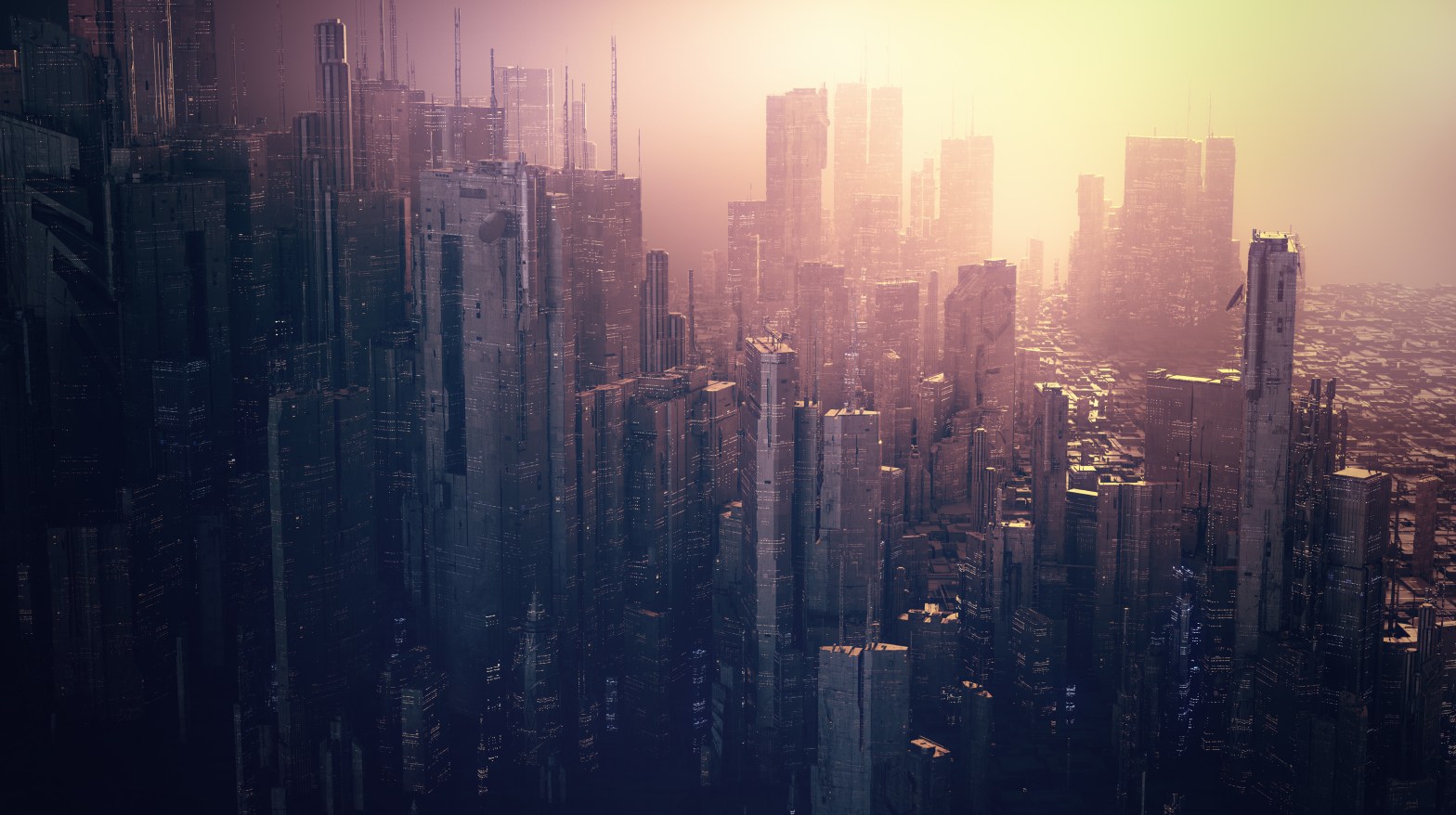
There’s a very clear traditional idea of what a fantasy world is supposed to be like. It has warriors riding horses and wielding swords and axes. It doesn’t have them travelling on planes and operating computers. It just doesn’t.
But why not? After all, our world has had all that and much, much more, at various times and locations. So why does a secondary world have to be frozen like a fly in amber? Sooner or later, all worlds have to grow up.
The Mediaeval World That Fantasy Isn’t
Perhaps the most widespread fallacy about fantasy secondary worlds is that they’re all mediaeval — by which people normally mean simply that they have horses and swords. In fact, “mediaeval” is a very specific range of cultures, relating to Western Europe between 732 and 1453 AD.1
Even so, customs and norms varied considerably between those dates and in different parts of Europe, but two crucial features can be picked out that define the era. One was the feudal system. The other was the unique position of the Church.
There are fantasy novels set in a genuinely mediaeval-style culture, of course. Martin’s A Song of Ice and Fire series is perhaps the most obvious, as well as William Morris’s works like The Well at the World’s End. However, they’re very much in the minority.
Consider the various societies portrayed in Lord of the Rings, for instance. The Shire is essentially rural 19th century England without gunpowder (apart from fireworks); the Dwarves are Vikings; Rohan is very early Anglo-Saxon, as portrayed in Beowulf; and Gondor is perhaps more like ancient Babylon than anything. Then there are other societies, such as the Elven kingdoms and Mordor, that have no particular historical model.
In fact, a more typical kind of fantasy world (especially when it comes to sword & sorcery) most closely resembles the world of Classical mythology. A world where rootless heroes wander between tiny kingdoms whose constitutional arrangements are sketchy, to say the least, and whose religions mostly seem to involve sacrificing beautiful virgins. For all its faults, the mediaeval Church tended not to do that.2
Fantasy in the Modern World
There’s always been fantasy set in our own contemporary world, of course, but secondary world fantasy has tended to be, if not mediaeval, certainly pre-gunpowder. There have been slight exceptions. In Andre Norton’s Witch World series, for instance, she goes as far as to give Witch World warriors dart guns, but there’s also futuristic tech — although it’s been brought in from outside their world.
More recently, though, some fantasy authors have been experimenting with different kinds of settings. That’s often been to do with a less Eurocentric focus, but some settings have been post-gunpowder, or even societies with similarities to the modern world.
The New Weird movement, whose best-known exponent is China Miélville, mixes genres. It typically employs invented urban fantasy settings, often with modern or steampunk overtones, but featuring a wide range of fantasy races and themes. In Miélville’s world of Bas-Lag, for instance (as featured in Perdido Street Station and other novels) dozens of strange and wonderful types of sentient beings coexist with railways and other Victorian-level technology.
One of my favourite examples of this movement is Mary Gentle’s Rats & Gargoyles. This is set in a vast city (we’re told it spreads over several time zones) which initially seems very much like a classic fantasy city, apart from being ruled by human-sized rats. As the story unfolds, though, we gradually realises that it actually possesses a wide range of modern technology.
Letting Worlds Grow Up
When I started writing stories in what was to become the Traveller’s World, it was very much a classic fantasy world. Right at the beginning, in fact, I was referring to characters as knights, and there was more than a hint of Arthurian legend about it, although this quickly morphed into something closer to classical Greece.
Quite early, I found my way to using different parts of the world and widely separated time periods, but they were all essentially pre-tech. I did allow a little progress, though at my own preferred rate (they had the printing press before gunpowder, for instance), but essentially it remained an “ancient” world.
Then, about twenty years ago, I began to reconsider. It occurred to me that, logically, at some point much later than anything I’d yet written, this world too would “grow up”. I began to wonder what this “modern” world would make of the major legends of its past, such as the Traveller.
The first fruit of this line of thinking was a story called Present Historic, in which a “modern” diplomat is inspired to pursue international cooperation by legends of the Traveller — which now appear as films and comic books. This idea fascinated me. Although I continued (and still continue) to write plenty of stories in “classic” settings, I began exploring this new, grown-up Traveller’s World.
Not all the settings are entirely modern. One is what I call “flintlock & sorcery” (a kind of fantasy equivalent of The Three Musketeers), while others are set in a gaslight era. Many, though, are set in a period that features equivalents of smartphones and PCs — and a few are even slightly in advance of our current level of progress.3
I’d already established, in the classic fantasy, that the Traveller’s World isn’t so very different from ours. It doesn’t have six moons, or bizarre sentient beings living side by side with humans (well, not many, at least), and I extended this into the modern era. Overall, the societies and their technologies have developed in ways similar to ours — though with certain differences. Cars are all electric, for instance, planes are VTOL, and you “dial up the vidscreen”, rather than turn on the TV. Broadly, though, it’s much the same.
Just like much contemporary fantasy set in our own world (especially paranormal fantasy) the predominant theme in these stories is the effect of the supernatural traditions of the past on a rational, sophisticated society. Here, it can be anything from people trying to revive worship of the Demon Queen or the Great One (the global power of evil) to finding remnants of ancient, paranormal races.
How Far Can a Secondary World Go?
So I have stories set in various iron age societies of the Traveller’s World (the comfort zone for fantasy) and also stories set in its “early modern” and “modern” eras. But are there are other periods that would work? How far can a secondary world go?
Well, possibilities do exist. I have a couple of stories set in the bronze age, for example — but there are limits. If I wanted to write stories about palaeolithic hunter-gatherers, for instance, what would distinguish it from a story set in that era of our world?
We know nothing really of the cultures or languages or beliefs from that far back, and the characters wouldn’t have names for the countries or areas they live in. Unless the secondary world had something quite distinct (those six moons, for instance), there’d be no difference between a story set in the forests of northern Europe and one set in the great Kimdyran Forest.4
Curiously, the same applies if you go too far beyond a “contemporary” setting. There’s certainly room to get a little futuristic, but when the people of the Traveller’s World start boldly going where no man has gone before, the universe they explore could just as well be the universe our descendants might explore.
Some heritage elements could be brought in, of course. Some of the cities back home might be the same, and a pioneering starship could be named Searcher, after the Traveller’s vessel. But these would be largely cosmetic elements. There’d be little true reason for the story being set in a secondary world.
So, it seems, the useful life of a secondary world is from the end of the stone age to the beginning of the interstellar age. Which leaves plenty of room to explore, whether your tastes run to sword & sorcery or to urban fantasy. Or both.
So have fun.
1 There are various reasons for singling out the Battle of Tours in 732 as the beginning of the Middle Ages, but the principal one was that it began the supremacy of the knight as a fighting force, with the feudal system that came along with it. The fall of Constantinople to the Ottomans in 1453 was significant in itself, but it also marked the point where all the major features of the early modern era were under way.
2 Unless you count burning heretics at the stake, of course.
3 An example of this is a story called Tattered Wings, in which even a fairly low-income family lives in a house with voice-activated lights and other systems.
4 I actually do have a palaeolithic story set in the Traveller’s World — but only because I say so. It could just as well be set in our prehistory.
 The Fantasy Worlds of Nyki Blatchley
One thought on “A Fantasy World That’s All Grown Up”