There have been a few moments in my writing life that have changed everything. One was a long walk I took the family dog on when I was fifteen, in the course of which I thought up and planned a story which proved to be the germ for much of what I’ve written since.
Another happened on the 31st January 2004, when I Googled “fantasy writing groups”, intending to search through what was out there to see if anything might be helpful. The first option I tried was a website called Fantasy-Writers.org. I joined, looked around and ignored the rest of the list.
More than twenty-one years later, I’m still part of FWO (as we like to call it), now as one of the site’s administrators. Virtually every story I’ve written since then has been through the FWO critiquing process, which has helped dozens get published — including a novel. I’ve learnt vast amounts about writing from the forum discussions, and from both giving and receiving critiques. And I’ve made a lot of good friends.
Eleven years ago, we published an anthology, Light of the Last Day, consisting of stories and poems by members. It turned out pretty well, but was extremely hard work — which is probably why it’s taken us till now to get to the follow-up.
This time, we decided to go for a theme. The concept of the Monomyth, or the Hero’s Journey, is a familiar one to many people. It was first proposed in 1949 by Joseph Campbell as a way of defining a common structure of stories, from ancient myths to contemporary media. He structured it as a hero on a journey involving a series of Jungian-style archetypes, which is at the same time a journey from childhood to adulthood.
Campbell’s Journey was a complex affair with seventeen stages, but more recently Christopher Vogler has proposed a simpler version, with only twelve stages. Essentially, the hero begins in their Ordinary World, goes through a series of challenges, dangers and opportunities to the quest’s fulfilment, and then returns with a real or virtual treasure as a reborn and transformed person.
Our plan was that each author should write a complete story relating to one specific stage of the Journey. Not as part of some overarching plot, but as a tapestry that, put together, would display every part of the Monomyth.
Although we toyed with the idea of twelve authors each claiming a specific stage, we decided to make it looser. We invited everyone to post a story on the site (either as part of our monthly challenge or more randomly) using any stage they liked. And then, as inevitably there were stages no-one had chosen, some authors submitted a second story, to help fill the gaps.
The upshot was that we ended up with twenty-two stories from seventeen authors, with every stage covered at least once. And then the fun began.
Each story underwent FWO’s usual process of peer critique — twice, for the first and second draft. Then, with all revisions complete, some of us volunteered to line-edit the stories, working on details such as grammar, punctuation and word choice. And, when both author and editor were happy, the stories were ready.
So what have we ended up with? These twenty-two stories are a mix of high fantasy, low fantasy, sword & sorcery, contemporary fantasy, and even a touch of science fiction and Afrofuturism. Not to mention one or two that defy classification. They might thrill you or make you think, they might make you laugh or cry. Fantasy covers it all.
FWO is a broad gathering of authors from many countries and many places along their writing journeys. Countries represented in this anthology include the USA, the UK, Australia, France, Germany, Malaysia, Egypt and Nigeria, and authors range from complete beginners to some who make their living from writing.
So the voices in the anthology might be idiosyncratic, and they use many different versions of the great Global English language — and that’s fine. Our variety is our strength. And, while we were prepared to find tactful ways of telling authors their stories weren’t quite up to scratch, it turned out that we didn’t need to. Which, I think, is a testament to the level of support we give each other in FWO.
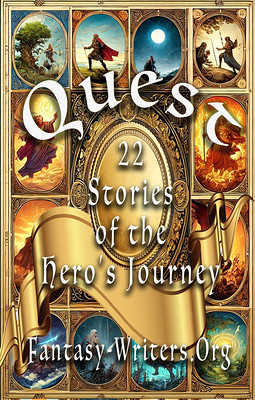
Generally speaking, this anthology has been a communal effort, but in the end it takes one person to pull it all together. I’d like to thank B. R. Turnage, who’s designed and assembled the book — not to mention creating the beautiful cover.
So what are my contributions to this book? Well, besides writing the introduction, I have two stories:
The Shape of a Legend uses the “Tests, Allies and Enemies” stage, and all those elements make up significant aspects of the story. That’s especially true of “tests”, as the central part of the story is a traditional fairy-tale “three tests” sequence — although not quite done in the traditional way
A young queen must choose between loyalty to her homeland and family and loyalty to her adopted land and the husband she loves. In the end, though, her magical allies show her that her real choice is about who she wants to be.
Wyrmbane uses the “Resurrection” stage. In the classic Hero’s Journey structure, this is normally interpreted metaphorically, but here it’s completely literal. Wyrmbane is a dragonslayer doomed to eternally fight, die and return to life to fight again.
Until, that is, a dragon offers him a way out. Is Wyrmbane willing to abandon his endless task in order to escape his fate?Quest: 22 Stories of the Hero’s Journey will be released over the summer — so watch this space for more information.
 The Fantasy Worlds of Nyki Blatchley
One thought on “Quest — A Fantasy-Writers.org Anthology”