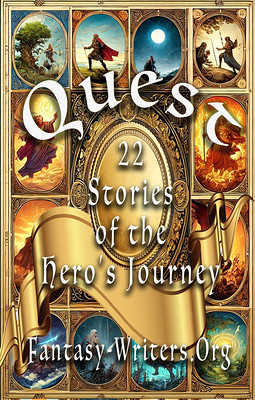
As I highlighted in a recent post, the writers’ group I belong to, Fantasy-Writers.org, is about to publish an anthology of members’ stories. This is Quest: 22 Stories of the Hero’s Journey.
To whet your appetite, this is an interview with David Staiger, one of the seventeen authors represented in the anthology, about his stories and his writing in general.
David’s stories are The Dragonfly Dish, which he describes as “a mythic quest involving beasts, barriers, and the elusive prize contained within a legendary vessel”, and The Last Virtue, described as “a lowborn champion must choose between fleeting fame and a true path forward in this tournament tale with a twist.”
What drew you to the Hero’s Journey structure for your story? Was it a challenge, a comfort or a surprise?
For the anthology in particular, I suggested the Hero’s Journey as a focal theme, as it represents a common starting point for many writers. We decided that each short story should tackle a different stage of the Journey, which is what, for me, proved to be the really fun challenge—trying to present a whole character arc within a single fragment of that larger arc. My writing does not follow a prescribed format, though I do have a pattern that I gravitate towards. I usually know where I am going in a story and fuddle around with how to get there along the way. I understand the developmental beats I want to hit, but I don’t hold to any specific formula or percentage breakdown to reach those checkpoints. Since I do know the theme and ending I am steering towards, I can always drop in small teases and set-ups ahead of time—not exactly structural foreshadowing, per se, but close enough to offer that impression.
Tell us about your stories in the anthology. What stage of the Hero’s Journey do they represent, and how did you interpret that beat?
I have two stories in the anthology, and I cannot remember which one I began first. I think I selected the resurrection stage first because no one else was grabbing for it (at least initially). When I hear “resurrection”, it invariably comes with the thought of death, specifically life-death-rebirth as part of the life cycle. So I wanted to have something die but not die, trapped in that in between. Once there, the ideas started rolling.
As part of the Hero’s Journey, specifically the Joseph Campbell version, I will always return to the image of Luke Skywalker entering the cave on Degobah and facing Darth Vader, which turns out to be his own dark self. It is the descent into the underworld, the shadow side of ourselves as human beings, that truly makes the stage significant. I needed a story that could represent that, so I needed a setting that could properly hold those elements and amplify that theme. Turns out I already had one.
I managed to export the setting, but I also required a different hero, so I stole that, too. I made Luke Skywalker, the parentless young teen on the cusp of adulthood with aspirations of becoming a knight. I changed the name, of course, and a few other details. In the back-and-forth story structure between past events and the present, it works well to escalate tension by keeping secrets. The best part of the story is the reveals. Knowing where you are going as an author makes hint-dropping and set-ups a breeze. And thematically, I have a setting with all the symbolism I could ever require. The sun is Life, and the moon/night is Death. The “past” part of the story stays in the daytime, while the “present” sections move from day to evening to the deep of night, suggesting that descent. The knight of Moonsmont could not be clearer if I tried—the embodiment of Death itself luring the dying hero in. Yeah, I had fun putting it all together, and throwing a little extra lore into my larger setting was a bonus.
As for the other story, I think I picked up the Ordeal because literally no one else did. Having no real ideas to start from, I had asked my fellow writers for some additional prompts as well. The magic of computer randomization gave me “daycare” as a setting, with Tender Moments and Jellybeans & Dragonflies presented as suggested names. I laughed, then sighed. I said, “I’ll see what I can do.” I had no idea where to begin.
Turns out, it was easier than I thought. Again, knowing where you are going makes the whole structure simple. What ordeal could a daycare toddler get themselves into? What are they after? How do I, the author, make that a compelling narrative in a fantasy-themed anthology? Calvin & Hobbes to the rescue. The story that came out in the anthology is pretty close to stream-of-thought. Sometimes the stories write themselves.
What’s your favourite type of hero—reluctant, chosen, flawed or fearless? Does your protagonist fit that mould?
I definitely prefer the flawed hero when it comes down to it. Not the overly-troped grim-and-pensive anti-hero, mind you, but the truly flawed hero. I prefer all my characters to be imperfect, to have failings, to wrestle with their inner demons. I believe that is what makes them most human, most like the people who are reading the story. We all have flaws, so why shouldn’t they? I love working in the gray area, in that murky soup of moral ambiguity that makes readers have to think and form their own opinions. I have characters that perform evil, despicable acts right alongside ones that rise to heroism on occasion. But driving those acts are the same muddy mess of moral confusion that drives us all. That contrast serves to highlight the importance of choice. Superman isn’t really brave or heroic, is he? He’s just invulnerable and better at everything. Rising to the occasion makes a hero, and the farther they are forced to rise, the greater the heroism truly is.
In the anthology, I’ll leave it to readers to decide if either protagonist can be considered a hero. Thi Cam Hanh, daughter of all daughters, says it herself with a laugh. She is only acting in self-interest, so she is the hero of her own story, certainly, but that’s as far as it goes. And Miekal in The Last Virtue isn’t really the hero either. He might struggle and overcome and lay it all on the line, but in the end, he gets himself fatally injured for pride. To me, the genuine hero of that story is Emely, the young graymaiden who rushes to heal him when he falls. It is her efforts alone, in opposition to the lure of Death, that brings him back.
Yeah, I definitely prefer my heroes messy.
What was the biggest challenge you faced while writing your story?
Keeping the word count manageable. That is always my biggest challenge. I have so much I want to say and so many minuscule details to express that, to me, are still important to the overall picture. It’s like micro-expressions in animation. The slightest narrowing of the eye or tilt of a lip can speak volumes louder than anything a character actually says or does. Good writing can be like that. It’s daunting to pack each sentence and word with every ounce of usable meaning. Sometimes, packing a sentence with two or three extra seemingly meaningless words can be a matter of voice and tone, of pacing and pause, rather than anything else. When every word of every sentence in every paragraph requires a justification for existence, I would call that a challenge.
If your main character had a theme song, what would it be?
Thi Cam Hanh: Get Jinxed by Djerv (League of Legends). I can definitely see a little manic-pixie-anarchist brewing in her. I would put it in the background of her conflict with the Beasts easily. And the crumbling of the Wall, surely.
Miekal Sevensons: I have to settle on Angels Fall by Breaking Benjamin. There’s certainly a tragic fatalism to his sense of prideful determination. He absolutely fills the broken-winged angel motif.
Why did you want to be part of this anthology? What does community writing mean to you?
If nothing else, Fantasy-Writers.org has provided the subtle but ever-present motivation to really pursue the projects I have always put off and forgotten about in the past. Having the extra eyes providing feedback and sharing thoughts on my work, even if it’s only a few people, gives me all the encouragement I need to keep going. The idea that someone out there is waiting for me to finish a story or might be looking forward to a new one is incredibly inspiring. I don’t understand what is wrong with Martin or Rothfuss, or even Muir. Don’t they understand people are waiting! Maybe they just need to join FWO to keep things moving. (The invitation is open — Nyki)
What’s your favourite classic or modern story that uses the Hero’s Journey? (Books, films, games—go wild.)
As I previously alluded, Star Wars, the original trilogy, is my go-to representation of the Hero’s Journey encapsulated. Somewhere out there, a college essay of mine shows how all the stages of the Hero’s Journey are on display through all three movies, as well as in a micro-context within just A New Hope by itself. I mean, descending into the Death Star—how much more underworldy can you make the symbolism?
I’m sure if I examined the many stories out there, I could find a bunch of my favorite books or movies that exemplify the model. To be honest, though, I don’t really ascribe to that story form all that much in my stories. It is great to be aware of, and to break some elements down after the fact, but as I also mentioned, I don’t usually set out to follow one plot model over another. Maybe I should, but that isn’t really how my brain functions at the moment.
What is one writing tip or lesson you learned through this project that you’d share with others?
Many hands make light work. It takes a village to raise a child. If you want something done right, do it yourself. Wax on, wax off. All that and more.
Seriously, one of the best things this project allowed—and that the site itself offers on some basic level—is the opportunity to edit each other’s work, both in terms of line and developmental editing. I have learned that I never want to be an editor in any professional capacity for any reason whatsoever. I can proofread or provide feedback and opinion on a story, but to actually do what the editor’s job is—nah, not for me. I put too much energy into my work to worry about what other people are doing in theirs. I am definitely not the hero on this journey.
Describe your writing style in three words.
Only three? Seriously?
Where can readers find more of your work?
As of this moment, I only have drabbles published. I have one in the Festival of Fear anthology from Black Ink Fiction and at least one in each of the past four years of Dark Moments from Black Hare Press. Oh, and I also have an honorable mention entry in the Weird Christmas Flash Fiction Contest for 2022. That’s it presently.
David Staiger lives with his family and assorted dogs in Upstate New York. In addition to writing, he enjoys hiking, mountain biking, rollerblading, and hockey. When he’s not in the classroom teaching special needs children, Dave argues with fellow FWOers about what makes a good story. Sometimes, he’s right. If he could, he’d make his living writing drabbles, but he’s found the scant pay-for-word won’t keep the mortgage company happy. While working on his WIPs, he has been published in two anthologies, Festival of Fear by Black Ink Press and Black Hare Press’ Fourth Year Anthology. He’s been a member of Fantasy-Writer’s.Org since March 2017.

