Generally speaking, I don’t do bizarre worlds. That doesn’t mean I don’t appreciate worlds that are carried through space by a turtle, or whose inhabitants are giant insects. Occasionally, I even create a bizarre setting for an individual short story.
My main secondary world, though, is very much in the “exactly like ours except for the details” mould. It’s an earth-type planet with an earth-type sun and moon, and mainly earth-type flora and fauna. Including humans who are just like us.
That doesn’t mean that everything’s the same. I have magical beings like the winged Eahui and monsters like the ice-worms and the kroukizh. For the most part, though, I’m exploring how things could develop in a world that’s like ours but not ours.
Every so often, however, I throw in something a little more baroque. One of my favourites, which has now featured in a number of varying-sized stories, is the city of Errish. A city that’s defined not by its horizontal spread but by its vertical growth.
Why Are Cities Where They Are?
In order to explain Errish, it’s important to understand that human settlements, whether they’re farms or major cities, aren’t positioned at random. They grow up in places that answer their most fundamental needs.
A farm or small village, for instance, needs a convenient source of water and plenty of land suitable for whatever type of farming they do. There’ll ideally be easy access to a source of wood, for construction and burning, and it may need to be in a defensible position.
When you get up to major cities, the needs are more complex, but most importantly is controlling significant routes for communication and trade. There are always exceptions, of course. The Hittite capital Hattusa, for instance, was in an inconvenient position on high ground, but maybe defensibility was seen as paramount. And, by the time Hattusa became the capital, no doubt tribute from the provinces provided all their needs.
Great cities are commonly on major navigable rivers or estuaries (navigable for pre-modern ships, at least) and some sites have persisted through the ages for good reason. The US city of St Louis, for instance, is in roughly the same position as the main city of the pre-Columbian Mississippi civilisation, and it’s easy to see why. Located at the confluence of the Mississippi and Missouri, it controls not only the route down to the sea, but also much of the continent’s interior.
Istanbul is another example. For nearly three thousand years, it was a prosperous Greek city, the eastern Roman capital, the Byzantine capital, the Ottoman capital and now a major city of modern Turkey. This is because the city controls the lucrative trade routes between the Mediterranean and the Black Sea, as well as one the narrowest crossing-points between Europe and Asia. Who wouldn’t want their city in such a position?
Why Is Errish Where It Is — and How It Is?
Well, Errish is one of those cities that just has to exist. It’s situated on the east coast of a very narrow isthmus linking two continents and dividing two oceans. Most of the isthmus is a mountain range — and there’s one point where the only viable route between the continents crosses the only viable route across the isthmus between oceans.
In other words, any city in that position will have complete control over all the main trade routes in that part of the world. It can’t help but become a great city.
There’s only one problem. The small stretch of coastal plain it stands on is hemmed between mountains and sea. There’s not room for a great pre-modern city, let alone a great modern one.
At first, this wouldn’t have been a problem. Very early Errish would have been small, and the land could have easily accommodated it. As it grew with its success, however, the available space would have quickly run out.
You see, the common idea that all pre-modern cities were small is simply wrong. Some were, depending on the period and the civilisation, but there have also been vast cities. Rome in the time of Augustus had a population of around a million. The walls of Babylon stretched for fifteen miles. And the great city of Angkor in Cambodia, which flourished during our mediaeval period, was around the size of a major modern city like London.
So Errish had to grow, and it chose a logical but unusual solution. It grew vertically.
The High Levels and the Undercity
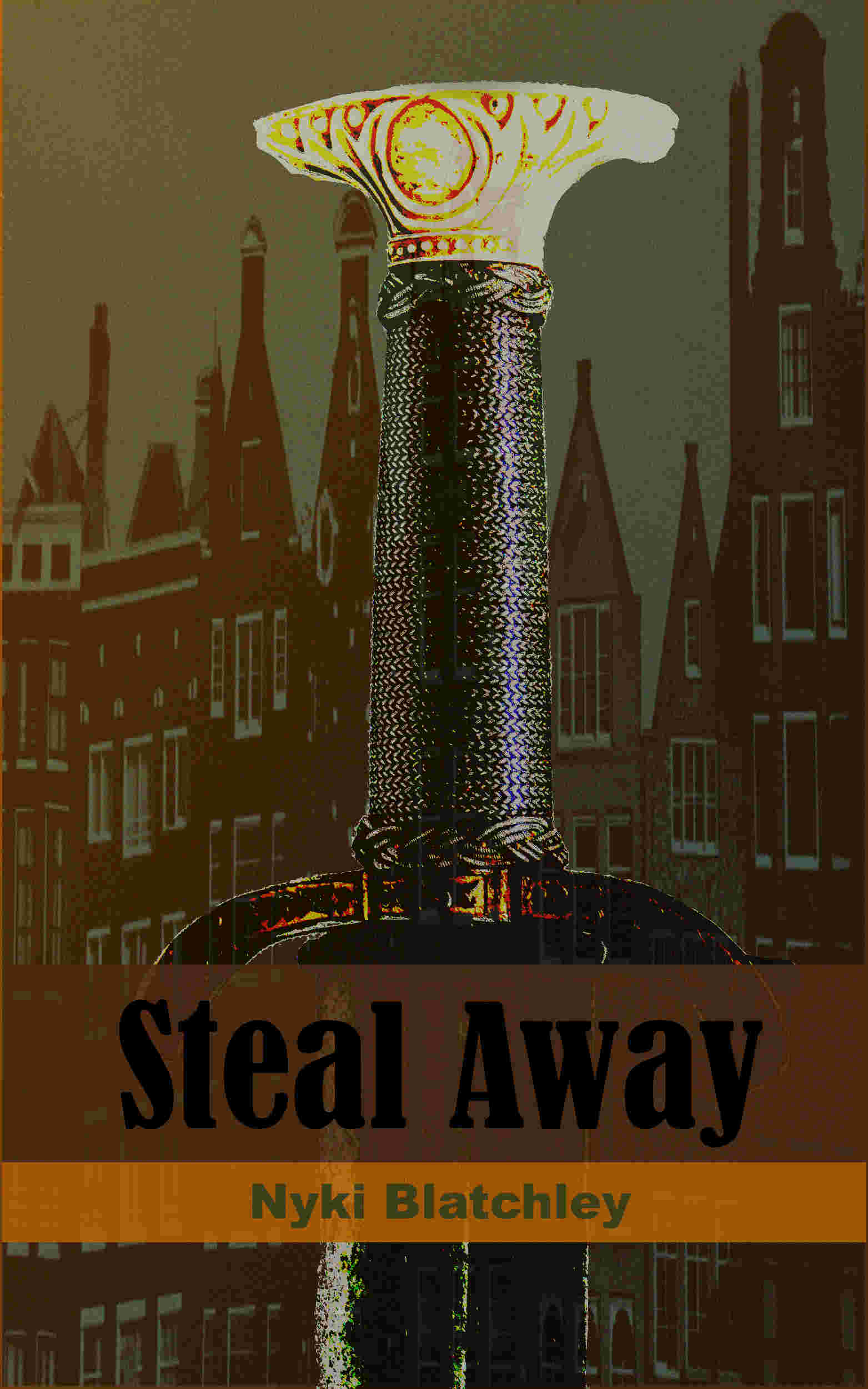
The initial solution was the simplest: to build upwards. In the story Steal Away, which is set just a few centuries into the Iron Age, buildings were already reaching six or seven storeys. This can be compared to the apartment blocks in classical Rome, which could reach up to nine storeys.
Heights increased over time. In a cosmopolitan city that attracted talented people from many countries, the conditions were right for the construction techniques they desperately needed to develop fast. Buildings were replaced by higher ones until, in the “modern” era (the era of planes, computers and mobile phones) a typical Errishi tower is around 120 storeys.
Upwards was only one direction for expansion, though. Even by the time of Steal Away, there was already an Undercity — an excavated area a hundred feet below ground, fully laid out with streets and houses. Just as the towers rose higher, so the Undercity went deeper over the centuries, until in the “modern” era there are twelve levels.
Needless to say, combining towers and excavations would have been a tricky engineering conundrum. There were certainly plenty of disasters, but the same pool of expertise that solved the problems of building higher also created a solution for this. The major structures in each Undercity level, as well as the many pillars that held the roof up, acted as support for the load above. In effect, each tower was supported by multiple piles around two thousand feet deep.
Life in a Vertical City
Probably the most obviously anomalous part of Errishi life is its transport system. While it has its cars, trains, buses and taxis, the main form of transport is its system of lifts. Or elevators, if you’re American.
The towers are routinely shared between private and public space, and while residents or workers have their own lifts, there are always public lifts serving the rest of the tower. This includes the roofs, which are public plazas with shops, bars and restaurants — always quite chic.
Meanwhile, the Undercity is served by numerous huge lifts, calling at each level and connecting with a “Deep-Train” system that runs beneath the lowest. These are usually packed at busy times.
Although it’s not a deliberate, enforced thing, there’s definitely a class divide between the affluent High Levels, the respectable Surface and the more proletarian Undercity. This certainly doesn’t mean, however, the Undercity is one big slum. Although there are slum districts, some levels have quite fashionable neighbourhoods — or at least what we’d call bohemian. Although this world has, of course, never had a country called Bohemia.
Essentially, this is just like the way certain districts or neighbourhoods in any big city will evolve from fashionable to poor and back again, sometimes without much rhyme or reason.
There are certainly challenges to the Undercity, at least for anyone not used to it. There’s obviously no sunlight, just artificial lights everywhere that mimic day and night. Some of the better-off levels have lamps that simulate sunlight, though the slums have to make do with sunlight deprivation.
And then there are the fans. In order to keep the air fresh, giant fans are blowing constantly, and their roaring is a ubiquitous noise in the Undercity. Anyone who lives down there (known as Subterras) barely notices it, but it can be challenging for Topsiders venturing down.
There’s no doubt, though, that the High Levels — the upper regions of the towers — are the home of privilege. The inhabitants can stroll between towers on walkways at many levels, or take flying taxis. No, we haven’t really cracked flying cars yet — but we haven’t had the same incentive as the affluent inhabitants of Errish’s High Levels.
The Evolution of Errish
Errish wasn’t always meant to be a vertical city. It originated as just a name, mentioned here and there as a great city far away, and it eventually found its way onto a map, positioned on that isthmus. I knew enough even back then about how cities work to realise that was a special position, but I hadn’t really thought through its implications.
I even had stories with scenes set in Errish, but without really showing any of the setting. But thinking about the place made me come to see some of the challenges it would face and some of the solutions its inhabitants might come up with.
I’ve always been fascinated by underground cities. I had one in a world I made up when I was quite a young child, a world where our cat was King of the Cats. Whenever I found myself on the beach, instead of building sandcastles like everyone else, I’d be excavating my underground city.
Twenty years ago, I wrote Steal Away, where the one Undercity level played a significant role, and the following year I wrote a “modern” story (now retired and cannibalised) that made much more use of the Undercity.
It was in 2015, though, that I first explored Errish in detail in a novella called The Amulet of the Worlds. Set in a “gaslight” period (perhaps roughly equivalent to the beginning of the 20th century), this was an occult thriller that explored the city from the High Levels down to Twelfth.
The Amulet of the Worlds is part of a story collection that’s been accepted for publication but is unfortunately currently stalled. But, when I tentatively started on a “fantasy Hitchcock” story, it felt natural to locate it in Errish.
Shadows in the City has grown into a short novel that I’ve just declared ready to go out into the world to seek gainful employment. Set in Errish’s computer age, it explores the city even more thoroughly than its predecessor. Just like the old film with the credit “co-starring the city of Paris”, this novel certainly co-stars the city of Errish. And I haven’t finished with Errish. There are districts I’ve barely touched and many aspects of its strange culture I could do a lot more with. While I don’t want to neglect all the rest of my world (seven continents and five thousand years of history), I doubt if I’ll be able to resist the lure of returning to the vertical city.

